
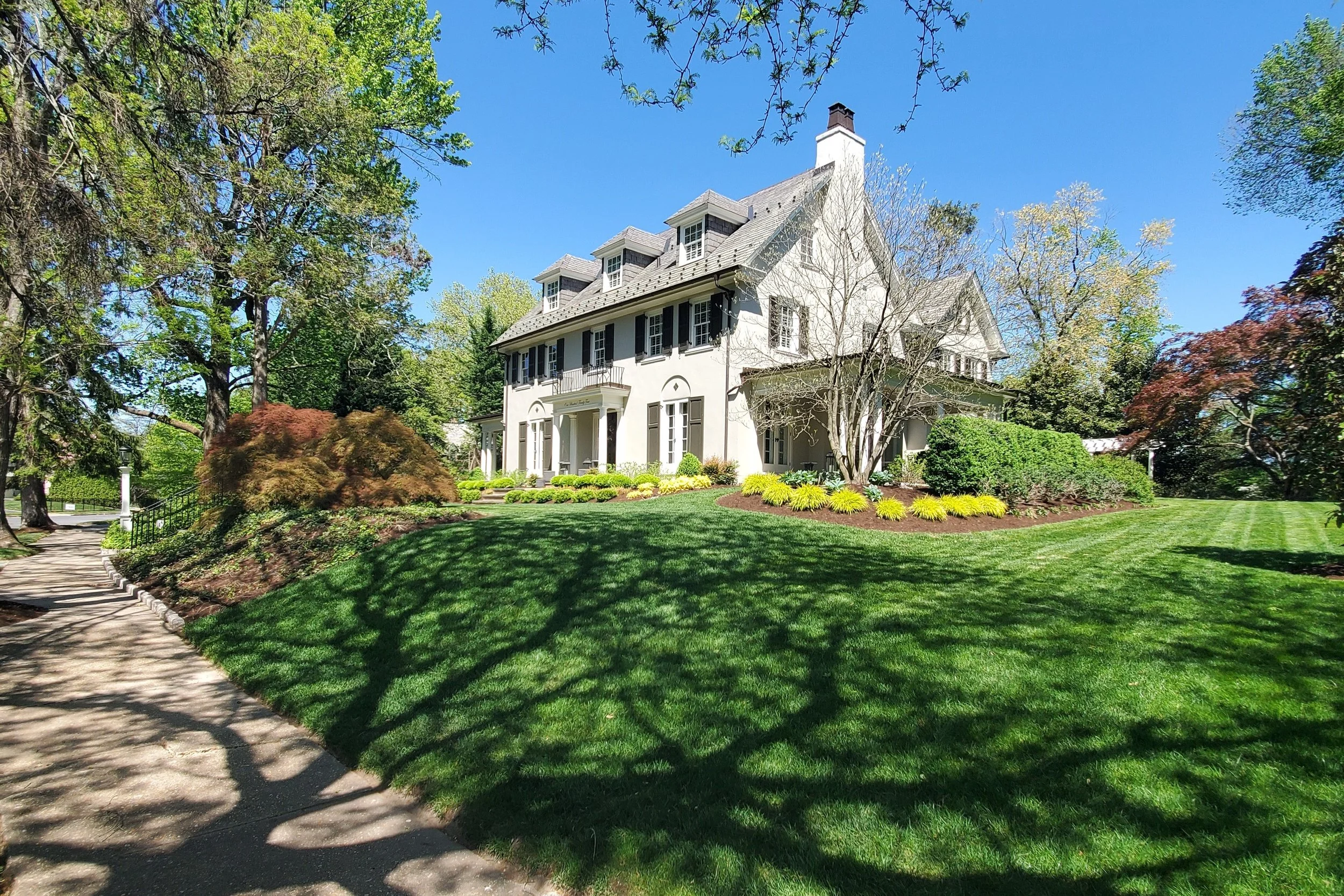
A traditional older home set within mature landscaping in Haddonfield, New Jersey. The image supports a discussion about the architect’s role in renovating 100-year-old homes, including listening to the client, evaluating original character, understanding neighborhood context, and preserving architectural value while adapting the home for modern living.
When renovating an absolutely beautiful 100-year-old home in a fantastic neighborhood, the architect’s role is not simply to make the house bigger, newer, or more fashionable. The real responsibility is more difficult than that.
A good renovation must solve the client’s needs while protecting the character, proportion, craftsmanship, and neighborhood presence that made the house worth saving in the first place.
At J Reinert Architecture, we often work with older homes in established communities such as Haddonfield, Haddon Heights, Moorestown, Cherry Hill, and surrounding South Jersey towns. These homes often have qualities that are difficult, if not impossible, to recreate today: mature neighborhoods, walkable streets, well-proportioned rooms, original millwork, real masonry, slate roofs, deep porches, carefully composed facades, and a sense of permanence.
The architect’s job is to understand what should change, what should remain, and how the new work can feel inevitable rather than imposed.
For us, that responsibility usually comes down to five primary roles.
1. Listen Carefully to Understand the Real Problem
The first responsibility of the architect is to listen carefully to the client and identify the essence of the problem they are trying to solve.
Most homeowners begin with a list of requested improvements: a larger kitchen, a mudroom, a primary suite, more natural light, better storage, an additional bathroom, or improved indoor-outdoor living. Those requests are important, but they are often symptoms of a deeper issue.
A family may say they need an addition, when the real problem is poor circulation. A homeowner may ask for a larger kitchen, when the actual issue is that the kitchen is isolated from daily life. Someone may want more space, when what they really need is better organization, better daylight, or a more intentional connection between rooms.
In our Center Hall Industrial Minimalism project in Haddonfield, the issue was not simply that the house needed to be repaired after storm damage. The deeper architectural problem was that the traditional center-hall layout limited movement, light, and connection through the home. By understanding the real problem, the renovation was able to do more than replace what had been damaged. It created a new sense of flow while still respecting the original house.
In a 100-year-old home, this distinction matters. Adding square footage without understanding the underlying problem can make the house larger but not better. It can also damage the scale, balance, and historic character of the original architecture.
The architect’s role is to listen beyond the wish list. How does the family live? Where does the house frustrate them? What parts of the home do they love? What routines are awkward? What views are missed? What spaces are avoided? What feels authentic and worth preserving?
A successful renovation begins when the architect understands not only what the client wants to change, but why.
2. Ask Challenging Questions to Clarify Priorities
The second responsibility is to ask challenging questions that help uncover the client’s true priorities and expectations.
Renovating an older home involves choices. Some are exciting; others are difficult. Budget, schedule, zoning, structure, preservation, energy performance, materials, and daily function all compete for attention. The architect helps the client understand these tradeoffs before decisions become expensive or irreversible.
Do you want the addition to blend quietly with the original house, or should it be more clearly contemporary? Is preserving the front elevation more important than maximizing square footage? Are you willing to give up some backyard space for a larger family room? Should the existing stair remain, even if moving it would improve the plan? Is the goal to restore the house, reinterpret it, or create a respectful contrast between old and new?
These are not always easy questions, but they are necessary ones.
In established neighborhoods, especially in towns with strong architectural identity, a renovation is not just a private project. It contributes to the street, the block, and the broader character of the community. The best residential architecture considers both the client’s needs and the home’s responsibility to its surroundings.
Our Artfully Done project in Haddon Heights is a good example of how personal priorities and neighborhood character can overlap. The project needed to support aging-in-place, first-floor living, art, family visits, and daily comfort, but it also needed to remain connected to the scale and spirit of a mature South Jersey neighborhood. The design process was not about choosing between old and new. It was about asking the right questions until the renovation found its proper balance.
Asking hard questions early helps avoid a renovation that looks good on paper but feels wrong once built. It also helps the client make decisions with clarity instead of reacting to each issue as it arises.
Good design is not about forcing an architect’s personal style onto a house. It is about guiding the client through a thoughtful process so the final result feels appropriate, intentional, and rooted in place.
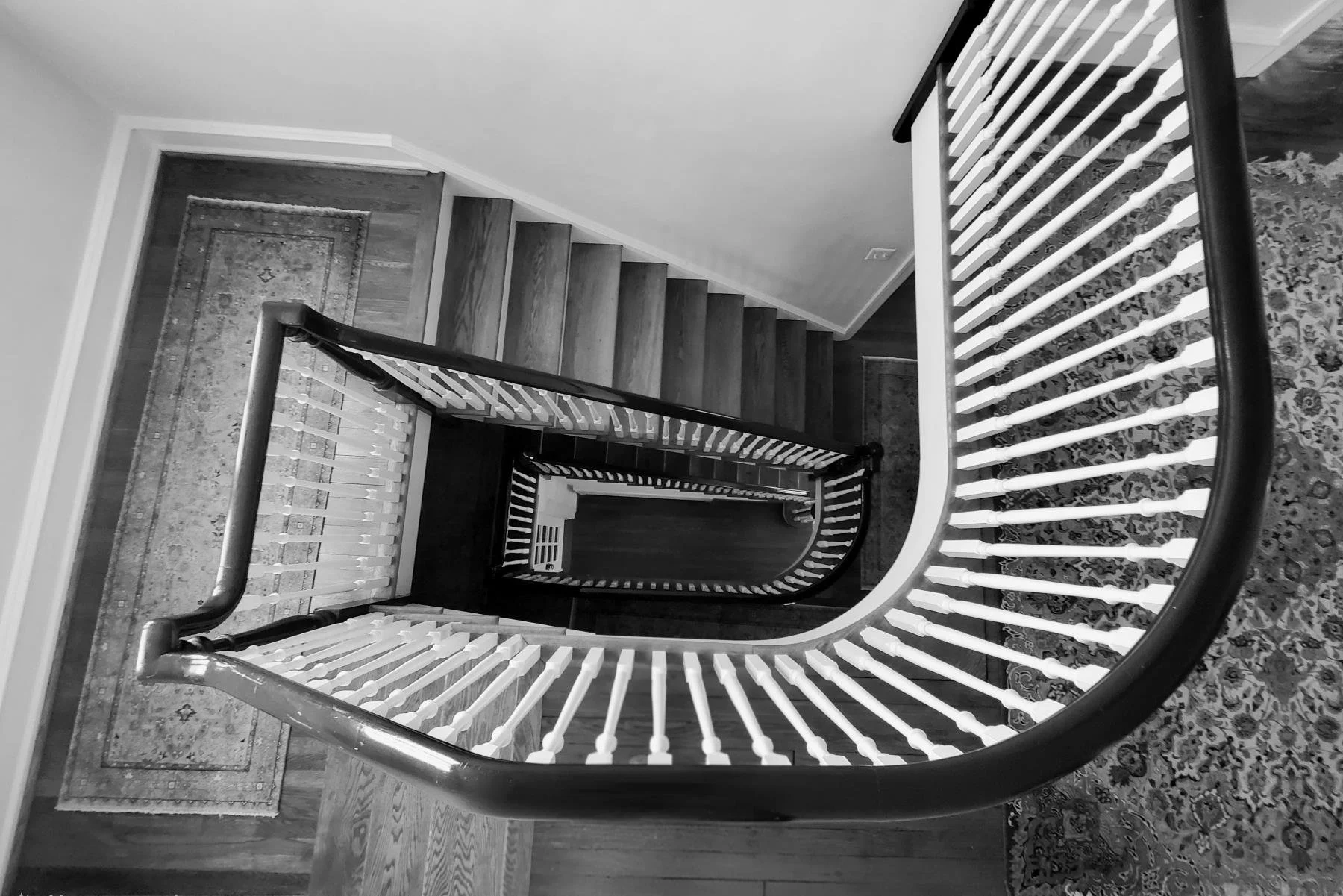
A black-and-white interior photograph looking down through a historic stairwell, showing the craftsmanship, proportion, and architectural character that should be considered when renovating an older home.
3. Evaluate What Is Original, Authentic, and Serviceable
The third responsibility is to carefully evaluate the quality and condition of the existing home.
Older houses are not all the same. Some have remarkable craftsmanship hidden beneath years of changes. Others have been altered repeatedly, with additions, finishes, or repairs that weakened the original design. Before deciding what to remove, restore, or reinterpret, the architect must understand what is actually there.
What parts of the home are original? What elements are authentic to the character of the house? What has been altered over time? Which materials are serviceable? Which details are worth preserving? Which conditions are failing and need to be replaced?
This evaluation might include the structure, rooflines, foundations, masonry, windows, trim, stairs, floor framing, fireplaces, porches, exterior materials, ceiling heights, and the relationship between rooms. It may also include less obvious qualities such as proportion, rhythm, symmetry, view corridors, and the way natural light moves through the house.
In many historic or older homes, the most important features are not always the most decorative. Sometimes the value is in the scale of the windows, the position of the stair, the depth of the porch, the relationship to the street, or the way the house sits on the lot.
The architect must be able to distinguish between character and clutter, between something worth saving and something that only appears old. Preserving everything can be just as problematic as removing everything. The goal is not nostalgia. The goal is judgment.
That same question guided our Mid-Century Modern Revisited project in Cherry Hill. The house had architectural intent worth protecting, but it also needed to be reorganized for contemporary living. The work required understanding what was authentic to the original mid-century modern home, what had been changed over time, and how the new work could restore clarity without turning the house into a museum.
A thoughtful renovation respects the original home without freezing it in time. It allows the house to continue serving modern life while retaining the qualities that give it meaning.
4. Understand the Surrounding Context
The fourth responsibility is to understand the broader context around the home.
A renovation does not exist in isolation. The architect must consider the neighborhood, adjacent buildings, landscape, zoning regulations, sun angles, wind direction, view opportunities, privacy concerns, drainage, outdoor living, and the way the house is experienced from the street.
In a mature neighborhood, these issues can be as important as the floor plan itself.
The location of an addition may affect how sunlight reaches the kitchen or backyard. A new window may create a beautiful view or an uncomfortable privacy issue. A porch may strengthen the home’s relationship to the street. A mudroom may need to respond to the way the family actually enters from the driveway. A new primary suite may need to capture morning light while avoiding exposure to a neighboring property.
Zoning also plays a significant role. Setbacks, lot coverage, building height, impervious coverage, stormwater requirements, historic district guidelines, and local review boards can all shape what is possible. In towns like Haddonfield, Haddon Heights, Moorestown, and other established South Jersey communities, understanding these constraints early can prevent wasted time and unrealistic expectations.
Context is not a limitation to good design. It is often what gives the design its direction.
Our Transitional New Build with Indoor/Outdoor Living in Haddonfield shows how privacy, orientation, outdoor space, and neighborhood context can shape the architecture from the beginning. Even in new construction, the same principles apply: the home must respond to the site, the street, the sun, the views, and the daily life of the client.
The best renovations respond to their setting. They understand the street, the landscape, the orientation, the age of the house, and the daily life of the people who live there. When done well, the new work feels like it belongs — not because it copies the past, but because it understands it.
5. Don’t Screw Up a Wonderful Treasure
The fifth responsibility is the simplest to say and the hardest to execute:
Don’t screw up a wonderful treasure.
A beautiful old house carries value beyond its square footage. It holds craftsmanship, memory, neighborhood character, and architectural presence. It may not function perfectly for modern life, but that does not mean its best qualities should be erased.
Too often, older homes are renovated in ways that strip away their identity. Original proportions are lost. Front elevations are overwhelmed. Additions become too large or too generic. Materials are flattened. Details are simplified. The house becomes more expensive, but less meaningful.
A successful renovation requires restraint. It requires knowing when to intervene and when to leave something alone. It requires understanding that the most impressive move is not always the right one.
At J Reinert Architecture, our goal is not to make an old home look brand new. Our goal is to help it live well for the next generation while preserving the qualities that made it special in the first place.
That may mean opening up the plan, but not destroying the original hierarchy of rooms. It may mean adding glass and light, but not compromising privacy or proportion. It may mean designing a contemporary addition, but one that respects the scale and rhythm of the original home. It may mean improving performance, comfort, and function while keeping the soul of the house intact.
Our work on projects such as White House, Black Windows & Shadow Garage reflects this same responsibility. The goal is not to overpower the existing home or neighborhood, but to make thoughtful architectural decisions that clarify the design, improve how the house lives, and strengthen the overall composition.
Renovating a 100-year-old home is an act of stewardship. The architect’s role is to guide change carefully, so the finished home feels both renewed and deeply rooted.
The best compliment is not, “Look how much they changed.”
The best compliment is, “It feels like this was always meant to be.”
To see more examples of how J Reinert Architecture approaches custom residential architecture, renovations, additions, and new homes in established New Jersey communities, visit our Selected Work or learn more about our Architecture Design Process.